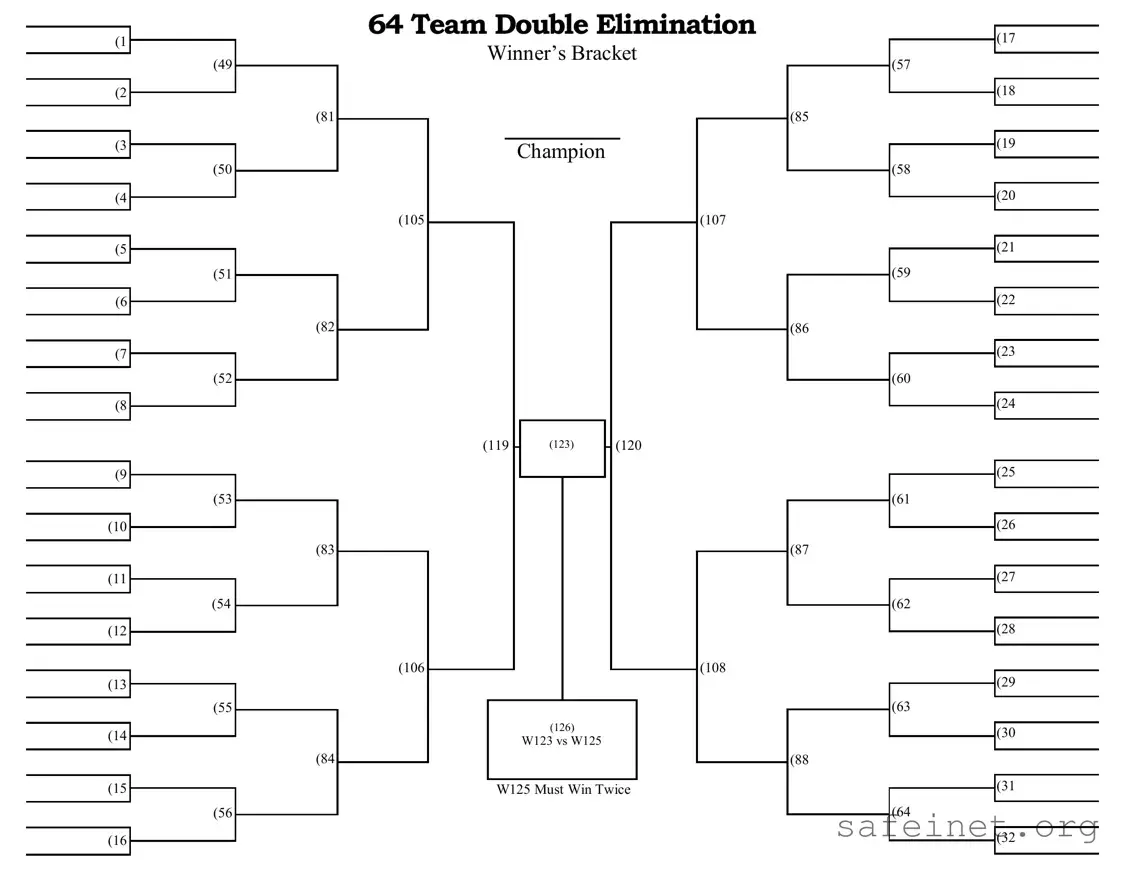
The 64 Team Double Elimination Bracket form is a popular structure used in various competitive settings, from sports tournaments to gaming competitions. This format allows teams to compete in a way that provides each participant with a second chance, ensuring that a single loss does not eliminate them from contention. With 64 teams entering the bracket, the excitement builds as they navigate through multiple rounds, culminating in a thrilling championship match. Each round is designed to pair teams against one another, with winners advancing and losers dropping into a lower bracket. This structure not only maintains a level of fairness but also keeps the competition engaging for both players and fans. The progression through the upper and lower brackets creates a dynamic atmosphere, as teams must strategize to overcome their opponents while also avoiding elimination. Overall, the 64 Team Double Elimination Bracket form offers a comprehensive and exhilarating way to manage large-scale competitions, emphasizing resilience and skill.
(1 |
64 Team Double Elimination |
(17 |
|
Winner’s Bracket |
|||
(49 |
(57 |
||
|
(2 |
|
|
|
|
RACKETS |
|
|
|
|
|
|
(18 |
|
|
(81 |
|
|
|
|
(85 |
(3 |
|
|
Champion |
|
|
(19 |
(50 |
|
|
|
|
|
(58 |
(4 |
|
|
|
|
|
(20 |
|
|
(105 |
|
|
(107 |
|
(5 |
|
|
|
|
|
(21 |
(51 |
|
|
|
|
|
(59 |
(6 |
|
|
|
|
|
(22 |
|
(82 |
|
B |
(86 |
||
(7 |
|
|
(23 |
|||
|
|
|
|
|
||
(52 |
|
|
|
|
|
(60 |
(8 |
|
OUR |
|
|
(24 |
|
(54 |
|
(120 |
|
(62 |
||
|
|
(119 |
(123) |
|
|
|
(9 |
|
|
|
|
|
(25 |
(53 |
Y |
|
|
|
(61 |
|
(10 |
|
|
|
(26 |
||
|
|
|
|
|
||
|
(83 |
|
|
|
|
(87 |
(11 |
|
|
|
|
|
(27 |
RINT(56 |
|
|
|
|
(64 |
|
(12 |
|
|
|
|
|
(28 |
(13 |
|
(106 |
|
|
(108 |
(29 |
(55 |
|
|
|
|
|
(63 |
P |
|
|
(126) |
|
|
(30 |
(14 |
|
|
W123 vs W125 |
|
|
|
|
(84 |
|
|
|
|
(88 |
(15 |
|
W125 Must Win Twice |
|
(31 |
||
|
|
|
||||
(16 |
|
|
|
|
|
(32 |
L9
(33
L10(65
Loser’s Bracket
L25
(41
(73L26
|
L49 |
|
|
|
|
|
|
|
RACKETS |
||||
|
|
|
|
|
|
|
|
|
|
|
|
L57 |
|
L11 |
|
|
(89 |
|
|
|
|
|
|
|
|
(93 |
L27 |
|
(34 |
|
|
|
|
|
|
|
|
|
|
|
(42 |
L12 |
|
(66 |
|
(97 |
|
L120 |
|
|
L119 |
|
(101 |
(74 |
L28 |
|
L50 |
|
L85 |
|
|
|
|
|
|
|
|
L81 |
L58 |
L13 |
|
|
|
|
|
|
|
|
|
|
|
|
L29 |
|
(35 |
|
|
|
|
|
|
|
|
|
|
|
(43 |
L14 |
|
(67 |
|
|
(109 |
|
|
|
|
|
(111 |
(75 |
L30 |
|
|
|
|
|
|
|
|
|
|
|
|
||
|
L51 |
|
|
|
|
|
|
|
|
|
|
|
L59 |
L15 |
|
|
(90 |
|
|
|
|
|
|
|
|
(94 |
L31 |
|
|
|
|
|
|
|
|
|
|
|
|
||
|
(36 |
|
|
|
|
|
B |
|
|
|
(44 |
||
L16 |
|
(68 |
|
(98 |
|
(113 |
(115 |
(102 |
(76 |
L32 |
|||
|
|
|
|
|
|
||||||||
|
|
|
|
|
|
|
|
||||||
|
|
|
|
|
|
|
|
|
|
|
|
||
|
L52 |
|
L86 |
|
|
(121 |
(124) |
(122 |
|
|
|
L82 |
L60 |
|
|
|
|
|
|
|
|
|
|
|
|
||
|
|
|
|
|
L105 |
|
|
|
|
|
L107 |
|
|
|
L53 |
|
L87 |
|
|
|
|
|
|
|
|
L83 |
L61 |
|
|
|
|
|
|
|
|
|
|
|
|
||
L1 |
|
(69 |
|
(99 |
Y |
|
|
|
|
(103 |
(77 |
L17 |
|
|
(37 |
|
|
|
|
|
(118 |
|
|
|
(45 |
||
|
|
|
|
|
(117 |
|
|
|
|
|
|||
|
|
|
(91 |
|
|
|
|
|
|
(95 |
|
||
L2 |
|
|
|
|
OUR |
|
|
|
|
L18 |
|||
|
|
|
|
|
|
|
|
|
|
||||
|
L54 |
|
|
|
|
|
|
|
|
|
L62 |
||
|
RINT |
|
|
|
|
|
|
||||||
L3 |
|
(70 |
|
|
(110 |
|
|
|
(112 |
(78 |
L19 |
||
|
(38 |
|
|
|
|
|
|
|
|
|
|
|
(46 |
L4 |
|
|
L88 |
|
|
|
|
|
|
|
|
L84 |
L20 |
|
L55 |
|
|
|
|
(114 |
|
|
|
(116 |
|
|
L63 |
L5 |
|
(71 |
|
(100 |
|
|
|
|
|
|
(104 |
(79 |
L21 |
P |
|
|
|
|
(125) |
|
|
|
|
|
(47 |
||
|
(39 |
|
|
|
|
|
W124 vs L123 |
|
|
|
|
|
|
|
|
|
(92 |
|
|
|
|
|
|
|
(96 |
|
|
L6 |
|
|
|
L106 |
|
|
|
|
|
L108 |
L22 |
||
|
L56 |
|
|
|
|
|
|
|
|
|
L64 |
||
|
|
|
|
|
Loser’s Bracket Final |
|
|
|
|
||||
L7 |
|
(72 |
|
|
|
|
|
|
(80 |
L23 |
|||
|
|
|
|
|
|
|
|
|
|
||||
|
|
|
|
|
|
|
|
|
|
|
|||
|
(40 |
|
|
|
|
PrintYourBrackets.com |
|
|
|
(48 |
|||
L8 |
|
|
|
|
|
|
|
|
L24 |
||||
|
|
|
|
|
|
|
|
|
|
|
|
||
| Fact Name | Description |
|---|---|
| Structure | A 64 team double elimination bracket allows each team to lose twice before being eliminated from the tournament. |
| Match Format | Teams compete in a series of matches, with the winners advancing in the winners' bracket and the losers moving to the losers' bracket. |
| Finals | The final match often involves the last remaining team from the winners' bracket facing the last team from the losers' bracket. |
| Governing Laws | State-specific forms may be governed by local sports regulations, which vary by state and organization. |
Once you have the 64 Team Double Elimination Bracket form, you can begin organizing your tournament. This form will help you track matchups and progress through the rounds, ensuring a smooth experience for all participants.
What is a 64 Team Double Elimination Bracket?
A 64 Team Double Elimination Bracket is a tournament format where teams compete in a series of matches. Each team must lose twice before being eliminated from the tournament. This structure allows for a more forgiving competition, giving teams a second chance to advance even after a loss.
How does the double elimination format work?
In this format, teams are placed in a bracket where they compete in head-to-head matches. After a team loses its first match, it moves to the "losers' bracket." Teams in this bracket can still win the tournament by winning all subsequent matches. The final match often involves the winner of the winners' bracket facing the winner of the losers' bracket, with the latter needing to win twice to claim the championship.
How are teams seeded in the bracket?
Seeding can vary based on the tournament's rules. Typically, teams are seeded based on their performance in previous competitions, rankings, or random selection. Higher-seeded teams are often matched against lower-seeded teams in the early rounds to ensure a balanced competition.
What happens if a team runs out of players?
If a team cannot field enough players for a match, they may forfeit that match. In a double elimination format, this typically counts as a loss. If a team forfeits two matches, they will be eliminated from the tournament.
Can a team come back after losing in the winners' bracket?
Yes, a team that loses in the winners' bracket is not eliminated immediately. They will drop to the losers' bracket, where they have the opportunity to continue competing. A team must lose again in the losers' bracket to be fully eliminated from the tournament.
How long does a 64 Team Double Elimination Tournament usually take?
The duration of the tournament depends on various factors, including the number of matches scheduled per day and the time allocated for each match. Generally, a 64-team tournament can take several days to complete, especially if matches are played in a single-elimination format.
Are there any tie-breaker rules?
Yes, tie-breaker rules can be established before the tournament begins. Common methods include additional matches, point differentials, or head-to-head results. It is essential to clarify these rules with all teams prior to the tournament to avoid confusion.
How is the champion determined in a double elimination format?
The champion is determined through the final matches between the winners of the winners' and losers' brackets. If the team from the losers' bracket wins, they often play one more match against the winners' bracket team to decide the ultimate champion, as they have not yet lost twice.
Can spectators attend the matches?
Typically, spectators are welcome to attend matches, but this may depend on the venue and any specific regulations in place. It's advisable to check with the tournament organizers for any restrictions or guidelines regarding attendance.
How can teams register for the tournament?
Teams can usually register through the tournament's official website or by contacting the organizers directly. Registration details, including deadlines and fees, should be clearly outlined to ensure all interested teams can participate.
Filling out a 64 Team Double Elimination Bracket can be a complex task. Here are ten common mistakes people often make when completing this form:
Not understanding the format. Many people overlook the double elimination structure, which allows teams to lose once before being eliminated.
Failing to label teams correctly. It's crucial to ensure that each team is clearly identified to avoid confusion during the tournament.
Ignoring the seeding process. Proper seeding is essential for fair competition, and neglecting this step can lead to mismatched games.
Forgetting to update the bracket after each round. Keeping the bracket current helps everyone track progress and understand upcoming matches.
Not including tiebreaker rules. Clarifying how ties will be resolved is important for maintaining order and fairness.
Overlooking the need for clear communication. Informing teams about their match schedules and results is vital for smooth operation.
Neglecting to account for byes. In a 64-team bracket, some teams may need to receive byes, and this should be planned in advance.
Using inconsistent terminology. Consistency in terms like "winner" and "loser" helps avoid misunderstandings among participants.
Not providing enough space for results. Ensure there is adequate room to write down scores and other important notes.
Rushing through the process. Taking time to carefully fill out the bracket can prevent many of the mistakes listed above.
By being aware of these common pitfalls, you can fill out the 64 Team Double Elimination Bracket more effectively and ensure a smoother tournament experience for everyone involved.
The 64 Team Double Elimination Bracket form is a vital tool for organizing tournaments where teams can lose once and still have a chance to compete for the championship. However, several other documents often accompany this form to ensure a smooth and well-structured tournament. Below are some of the key documents that are commonly used in conjunction with the bracket form.
Utilizing these documents in conjunction with the 64 Team Double Elimination Bracket form can significantly enhance the organization and execution of a tournament. Each document plays a unique role in ensuring that the event runs smoothly and efficiently.
The 64 Team Double Elimination Bracket form is similar to a Single Elimination Bracket form, which is commonly used in tournaments. In a Single Elimination format, teams compete in matches, and the loser of each match is eliminated from the tournament. This structure is straightforward and easy to understand, making it ideal for events with a large number of participants. However, unlike the double elimination format, once a team loses in a single elimination bracket, they are out of the tournament entirely, which can lead to quicker outcomes but less opportunity for teams to recover from an early loss.
Another document that shares similarities is the Round Robin Tournament Schedule. In a Round Robin format, each team plays against every other team, allowing for a comprehensive evaluation of performance. This format differs from the double elimination bracket because it does not eliminate teams based on losses. Instead, teams accumulate points based on their wins, which can lead to a more accurate representation of overall skill. However, it can be more time-consuming due to the number of matches required.
The Pool Play Bracket is another document that resembles the 64 Team Double Elimination Bracket. In pool play, teams are divided into smaller groups where they compete in a series of matches. The top teams from each pool then advance to a knockout stage, similar to the way teams progress in a double elimination bracket. Both formats allow for teams to have multiple chances to compete, but pool play requires careful organization to manage the initial group stages effectively.
A Swiss System Tournament format also shares characteristics with the double elimination bracket. In a Swiss system, participants compete in several rounds, with each round pairing teams based on their current scores. This system allows for teams to face opponents of similar skill levels, which can lead to more competitive matches. While it does not eliminate teams, it does provide a structured way to determine rankings, similar to how a double elimination bracket determines a champion through a series of matches.
The Best-of series format is another document that has similarities to the double elimination bracket. In a best-of series, teams compete in multiple matches, and the first team to win a predetermined number of matches is declared the winner. This format allows teams to have a chance to recover from a loss, much like the double elimination structure. However, it is typically used in series rather than a single tournament bracket, making it more common in professional leagues.
The Challenge Ladder document is also comparable to the 64 Team Double Elimination Bracket. In a challenge ladder format, participants can challenge others ranked above them for a match. If they win, they move up the ladder. This format encourages continuous competition and allows for multiple chances to improve rankings, similar to how teams can continue to compete in a double elimination bracket after a loss. Both formats promote engagement and provide opportunities for teams to demonstrate their skills.
Finally, the League Play document shares similarities with the double elimination bracket. In league play, teams compete over a set period, with each team playing multiple matches against various opponents. The overall standings are determined by the total wins and losses. While league play does not eliminate teams based on performance, it allows for multiple opportunities to succeed, similar to how teams in a double elimination bracket can bounce back from a loss and continue competing for the championship.
When filling out the 64 Team Double Elimination Bracket form, it’s important to follow certain guidelines to ensure accuracy and clarity. Here are some things you should and shouldn’t do:
When it comes to the 64 Team Double Elimination Bracket, several misconceptions can cloud understanding. Let’s clear the air by addressing these common misunderstandings.
This is true, but it’s important to note that teams can still advance in the bracket even after a loss. The format allows for a second chance.
While the winner of the winners' bracket is in a strong position, they must still compete against the winner of the losers' bracket in a final match.
In a double elimination format, some teams may play more games than others based on their wins and losses.
In a double elimination bracket, a single loss does not eliminate a team. They simply move to the losers' bracket for another chance.
While it may seem complex at first glance, the structure is designed to be straightforward. Once you understand the flow, it becomes much easier to follow.
The championship may involve multiple matches, especially if the winner of the losers' bracket defeats the winner of the winners' bracket.
Teams are divided into different sections of the bracket based on seeding, which can affect their path to the championship.
Understanding these points can help clarify how the 64 Team Double Elimination Bracket works. With the right knowledge, you can navigate the tournament structure with confidence.
When filling out and using the 64 Team Double Elimination Bracket form, consider the following key takeaways: