Homepage > Blank 508 From Nc Dwi Services Template
Article Structure

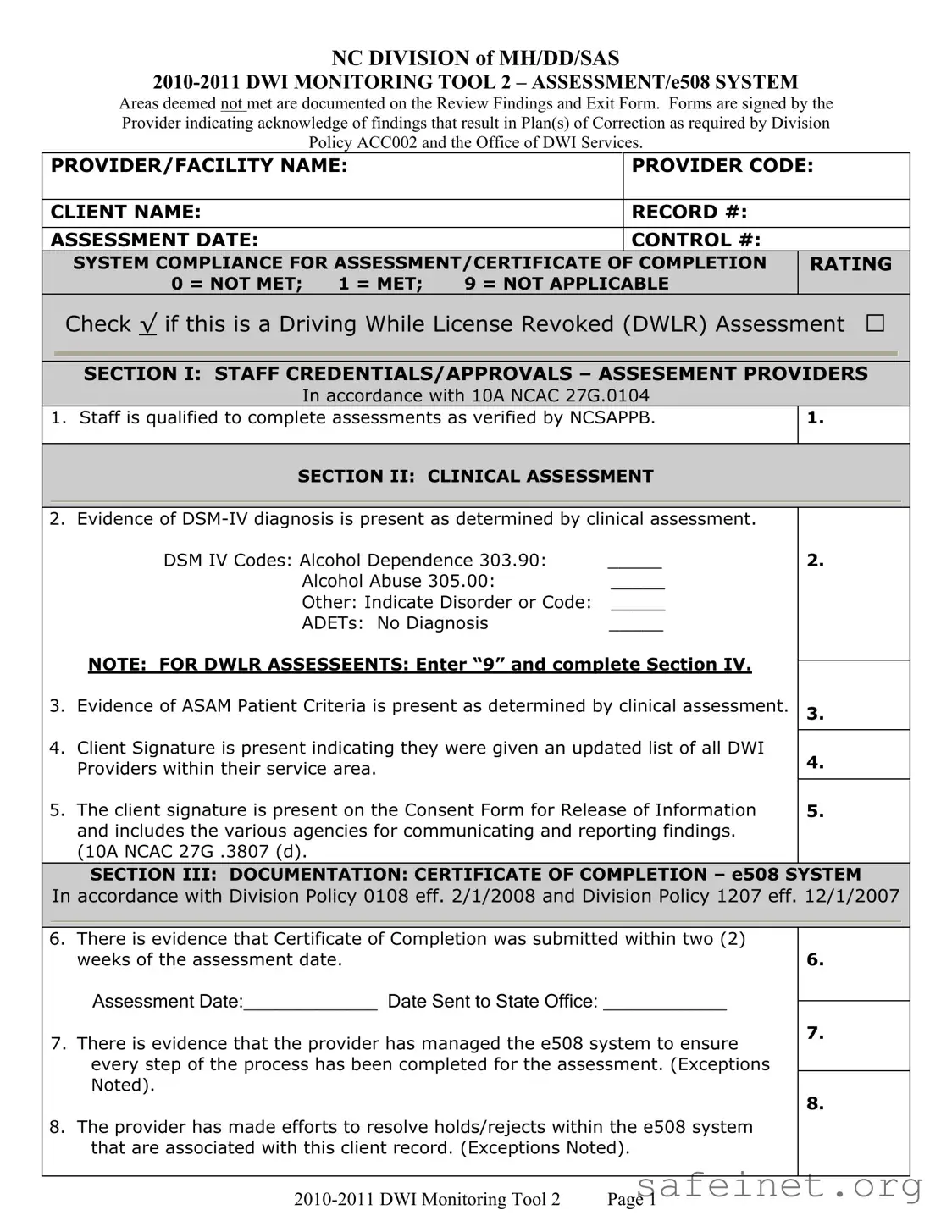
The 508 Form from NC DWI Services serves as a critical tool for assessing individuals involved in driving while impaired (DWI) cases. This form includes several key sections that ensure comprehensive evaluations and compliance with state policies. First, it addresses the qualifications of assessment providers, confirming that staff members are certified and capable of conducting these evaluations. The clinical assessment section follows, requiring evidence of a diagnosis based on established criteria, including DSM-IV codes for various alcohol-related disorders. Additionally, the form captures essential client information, such as consent for the release of information and acknowledgment of available DWI providers in the area. A significant focus is placed on documentation, particularly the timely submission of a Certificate of Completion, which must be sent to the state office within two weeks of the assessment date. The form also includes specific provisions for cases where a driver's license has been revoked, detailing the necessary clinical findings and any referrals for treatment. Overall, the 508 Form plays a vital role in ensuring that assessments are conducted thoroughly and that appropriate corrective actions are taken when necessary.
Form Sample

NC DIVISION of MH/DD/SAS
2010-2011 DWI MONITORING TOOL 2 – ASSESSMENT/e508 SYSTEM
Areas deemed not
met are documented on the Review Findings and Exit Form. Forms are signed by the
Provider indicating acknowledge of findings that result in Plan(s) of Correction as required by Division
Policy ACC002 and the Office of DWI Services.
2010-2011 DWI Monitoring Tool 2 Page 1
PROVIDER/FACILITY NAME:
PROVIDER CODE:
CLIENT NAME: RECORD #:
ASSESSMENT DATE: CONTROL #:
SYSTEM COMPLIANCE FOR ASSESSMENT/CERTIFICATE OF COMPLETION
0 = NOT MET; 1 = MET; 9 = NOT APPLICABLE
RATING
Check if this is a Driving While License Revoked (DWLR) Assessment
SECTION I: STAFF CREDENTIALS/APPROVALS – ASSESEMENT PROVIDERS
In accordance with 10A NCAC 27G.0104
1. Staff is qualified to complete assessments as verified by NCSAPPB.
1.
SECTION II: CLINICAL ASSESSMENT
2.
3.
4.
2. Evidence of DSM-IV diagnosis is present as determined by clinical assessment.
DSM IV Codes: Alcohol Dependence 303.90: _____
Alcohol Abuse 305.00: _____
Other: Indicate Disorder or Code: _____
ADETs: No Diagnosis _____
NOTE: FOR DWLR ASSESSEENTS: Enter “9” and complete Section IV.
3. Evidence of ASAM Patient Criteria is present as determined by clinical assessment.
4. Client Signature is present indicating they were given an updated list of all DWI
Providers within their service area.
5. The client signature is present on the Consent Form for Release of Information
and includes the various agencies for communicating and reporting findings.
(10A NCAC 27G .3807 (d).
5.
SECTION III: DOCUMENTATION: CERTIFICATE OF COMPLETION – e508 SYSTEM
In accordance with Division Policy 0108 eff. 2/1/2008 and Division Policy 1207 eff. 12/1/2007
6.
7.
6. There is evidence that Certificate of Completion was submitted within two (2)
weeks of the assessment date.
Assessment Date:_____________ Date Sent to State Office: ____________
7. There is evidence that the provider has managed the e508 system to ensure
every step of the process has been completed for the assessment. (Exceptions
Noted).
8. The provider has made efforts to resolve holds/rejects within the e508 system
that are associated with this client record. (Exceptions Noted).
8.
NC DIVISION of MH/DD/SAS
2010-2011 DWI MONITORING TOOL 2 – ASSESSMENT/e508 SYSTEM
Areas deemed not
met are documented on the Review Findings and Exit Form. Forms are signed by the
Provider indicating acknowledge of findings that result in Plan(s) of Correction as required by Division
Policy ACC002 and the Office of DWI Services.
2010-2011 DWI Monitoring Tool 2 Page 2
9. Certificate of Completion Form which indicates date sent to State Office
has been signed by professional staff and placed within client file. (Date
Sent to State Office does not indicate <blank>).
9.
SECTION IV: DRIVING WHILE LICENSE REVOKED – DWLR
In accordance with Statutory Reference G.S. 20-28
OVERALL
10.
a.
b.
c.
d.
10. Diagnosis was based on clinical assessment that indicates:
a. Early Full Remission _____
b. Sustained Remission _____
c. Partial Remission _____
d. Other: _____
11. Client was referred to treatment based on diagnosis of partial remission.
11.
COMMENTS: (Use Additional Comments Sheet as needed)
Findings require corrective actions: (Circle) YES NO
Auditor Instructions
Use Comments section to indicate areas of noncompliance that result in a Plan of
Correction (POC) and provide details to support findings
Reviewer Signature:
Date:
NC DIVISION of MH/DD/SAS
2010-2011 DWI MONITORING TOOL 2 – ASSESSMENT/e508 SYSTEM
Areas deemed not
met are documented on the Review Findings and Exit Form. Forms are signed by the
Provider indicating acknowledge of findings that result in Plan(s) of Correction as required by Division
Policy ACC002 and the Office of DWI Services.
2010-2011 DWI Monitoring Tool 2 Page 3
ADDITIONAL COMMENTS
_________________________________________________________________________________________________________
_________________________________________________________________________________________________________
_________________________________________________________________________________________________________
_________________________________________________________________________________________________________
_________________________________________________________________________________________________________
_________________________________________________________________________________________________________
_________________________________________________________________________________________________________
_________________________________________________________________________________________________________
_________________________________________________________________________________________________________
_________________________________________________________________________________________________________
_________________________________________________________________________________________________________
_________________________________________________________________________________________________________
_________________________________________________________________________________________________________
_________________________________________________________________________________________________________
_________________________________________________________________________________________________________
_________________________________________________________________________________________________________
_________________________________________________________________________________________________________
_________________________________________________________________________________________________________
_________________________________________________________________________________________________________
_________________________________________________________________________________________________________
_________________________________________________________________________________________________________
_________________________________________________________________________________________________________
_________________________________________________________________________________________________________
_________________________________________________________________________________________________________
_________________________________________________________________________________________________________
_________________________________________________________________________________________________________
_________________________________________________________________________________________________________
_________________________________________________________________________________________________________
_________________________________________________________________________________________________________
_________________________________________________________________________________________________________
_________________________________________________________________________________________________________
_________________________________________________________________________________________________________
_________________________________________________________________________________________________________
_________________________________________________________________________________________________________
_________________________________________________________________________________________________________
_________________________________________________________________________________________________________
NC DIVISION of MH/DD/SAS
2010-2011 DWI MONITORING TOOL 2 – ASSESSMENT/e508 SYSTEM
Areas deemed not
met are documented on the Review Findings and Exit Form. Forms are signed by the
Provider indicating acknowledge of findings that result in Plan(s) of Correction as required by Division
Policy ACC002 and the Office of DWI Services.
2010-2011 DWI Monitoring Tool 2 Page 4
ADDITIONAL COMMENTS
_________________________________________________________________________________________________________
_________________________________________________________________________________________________________
_________________________________________________________________________________________________________
_________________________________________________________________________________________________________
_________________________________________________________________________________________________________
_________________________________________________________________________________________________________
_________________________________________________________________________________________________________
_________________________________________________________________________________________________________
_________________________________________________________________________________________________________
_________________________________________________________________________________________________________
_________________________________________________________________________________________________________
_________________________________________________________________________________________________________
_________________________________________________________________________________________________________
_________________________________________________________________________________________________________
_________________________________________________________________________________________________________
_________________________________________________________________________________________________________
_________________________________________________________________________________________________________
_________________________________________________________________________________________________________
_________________________________________________________________________________________________________
_________________________________________________________________________________________________________
_________________________________________________________________________________________________________
_________________________________________________________________________________________________________
_________________________________________________________________________________________________________
_________________________________________________________________________________________________________
_________________________________________________________________________________________________________
_________________________________________________________________________________________________________
_________________________________________________________________________________________________________
_________________________________________________________________________________________________________
_________________________________________________________________________________________________________
_________________________________________________________________________________________________________
_________________________________________________________________________________________________________
_________________________________________________________________________________________________________
_________________________________________________________________________________________________________
_________________________________________________________________________________________________________

Document Specifications

Fact Name Description
Form Title The form is officially titled "2010-2011 DWI Monitoring Tool 2 – Assessment/E508 System."
Governing Law This form is governed by Division Policy ACC002 and the Office of DWI Services in North Carolina.
Provider Signature Providers must sign the form to acknowledge findings that may lead to a Plan of Correction.
Client Information Essential client details such as name, record number, and assessment date must be included.
Assessment Compliance The form assesses compliance using a rating system: 0 for not met, 1 for met, and 9 for not applicable.
Staff Credentials Staff qualifications must be verified by the North Carolina Substance Abuse Professional Practice Board (NCSAPPB).
Documentation Requirements Evidence of a Certificate of Completion must be submitted within two weeks of the assessment date.
Client Consent Client signatures are required on the Consent Form for Release of Information.
DWLR Assessments Specific guidelines apply for Driving While License Revoked (DWLR) assessments, including documentation.
Comments Section A section is available for additional comments, particularly regarding noncompliance and corrective actions.

Steps to Filling Out 508 From Nc Dwi Services

Filling out the 508 Form for NC DWI Services is an important step in the assessment process. This form requires careful attention to detail to ensure all necessary information is provided accurately. Below are the steps to guide you through the completion of this form.

  1. Begin by entering the Provider/Facility Name and Provider Code at the top of the form.
  2. Next, fill in the Client Name and Record # to identify the individual being assessed.
  3. Provide the Assessment Date and Control # in the designated fields.
  4. If applicable, check the box indicating this is a Driving While License Revoked (DWLR) Assessment.
  5. In Section I, confirm that the staff is qualified to complete assessments as verified by NCSAPPB.
  6. In Section II, document the evidence of DSM-IV diagnosis. Fill in the corresponding codes for Alcohol Dependence, Alcohol Abuse, or any other disorder as necessary.
  7. Ensure that evidence of ASAM Patient Criteria is present as determined by clinical assessment.
  8. Obtain the client's signature indicating they have received an updated list of all DWI Providers in their service area.
  9. Collect the client's signature on the Consent Form for Release of Information, ensuring it includes all necessary agencies for communication and reporting.
  10. Move to Section III and confirm that the Certificate of Completion was submitted within two weeks of the assessment date. Record the Assessment Date and the Date Sent to State Office.
  11. Verify that the provider has managed the e508 system to ensure every step of the process has been completed for the assessment.
  12. Document any efforts made to resolve holds or rejects within the e508 system associated with this client record.
  13. Ensure the Certificate of Completion Form is signed by professional staff and included in the client file, noting the date sent to the State Office.
  14. In Section IV, document the diagnosis based on clinical assessment, including remission status if applicable.
  15. Finally, use the comments section to note any findings that require corrective actions and provide details to support these findings.

More About 508 From Nc Dwi Services

What is the purpose of the 508 Form NC DWI Services?

The 508 Form is designed to facilitate the assessment and monitoring of individuals who have been charged with Driving While Impaired (DWI) in North Carolina. It serves as a structured tool for providers to evaluate a client's condition and ensure compliance with state regulations.

Who is required to complete the 508 Form?

Licensed providers who conduct assessments for individuals with DWI offenses are responsible for completing the 508 Form. This includes ensuring that all necessary information is accurately documented and submitted in accordance with state guidelines.

What information is collected on the 508 Form?

The form collects essential information such as the provider's name, client details, assessment date, and compliance ratings. It also requires documentation of clinical assessments, including any diagnoses and the client's consent for information release.

How is compliance rated on the 508 Form?

Compliance is rated using a simple scale: 0 for not met, 1 for met, and 9 for not applicable. This rating system helps to identify areas that require attention or corrective actions.

What happens if areas are deemed not met?

If certain areas are marked as not met, these findings must be documented on the Review Findings and Exit Form. The provider must acknowledge these findings and develop a Plan of Correction as required by state policy.

What is the significance of the Certificate of Completion?

The Certificate of Completion indicates that the assessment process has been finalized and must be submitted to the state office within two weeks of the assessment date. This certificate is crucial for maintaining compliance and ensuring that all necessary steps have been completed.

What should be done if there are holds or rejects in the e508 system?

Providers are expected to manage any holds or rejects associated with a client record in the e508 system. Efforts should be made to resolve these issues promptly to ensure that the assessment process remains on track.

How does the form address Driving While License Revoked (DWLR) assessments?

For DWLR assessments, specific sections of the form must be completed, including documentation of the client's diagnosis and any referrals to treatment based on that diagnosis. This tailored approach helps to address the unique needs of clients in this category.

What should be included in the comments section of the form?

The comments section allows providers to note any noncompliance areas that may require corrective actions. It is also a space to provide additional details that support the findings and enhance the understanding of the assessment process.

How can clients ensure their rights are protected during the assessment?

Clients should review the consent forms carefully and ensure they understand what information will be shared and with whom. Their signature on the Consent Form for Release of Information indicates that they agree to the communication of findings among relevant agencies.

Common mistakes

  1. Incomplete Information: Failing to fill in all required fields, such as the provider name, client name, or assessment date, can lead to delays in processing the form.

  2. Incorrect Ratings: Misunderstanding the rating system can result in inaccurate assessments. Ensure you check the appropriate boxes for compliance ratings.

  3. Missing Signatures: Not obtaining necessary signatures from the client or provider can invalidate the form. Always confirm that all required signatures are present.

  4. Failure to Document Exceptions: If there are exceptions noted during the assessment, these must be clearly documented. Omitting this information can lead to misunderstandings.

  5. Ignoring Submission Deadlines: Certificates of Completion must be submitted within two weeks of the assessment date. Missing this deadline may result in noncompliance.

  6. Inaccurate Diagnosis Codes: Providing incorrect DSM-IV codes or failing to include them can lead to complications in treatment planning. Double-check the codes before submission.

  7. Neglecting to Review Findings: Not reviewing the findings and comments section can lead to missed corrective actions. Always ensure you understand the requirements for compliance.

Documents used along the form

When dealing with the 508 Form from NC DWI Services, several other forms and documents often come into play. Each of these documents plays a crucial role in ensuring compliance, documenting findings, and guiding individuals through the process of assessment and treatment. Here’s a brief overview of some essential forms you might encounter.

  • Review Findings and Exit Form: This form documents areas where compliance was not met during assessments. It includes findings that may require corrective actions and is signed by the provider to acknowledge these findings.
  • Certificate of Completion: This document verifies that a client has completed the necessary assessments and treatments. It must be submitted within two weeks of the assessment date and signed by a professional staff member.
  • Consent Form for Release of Information: Clients must sign this form to allow communication between various agencies. It ensures that relevant information can be shared for reporting findings and coordinating care.
  • Plan of Correction (POC): If any areas of noncompliance are noted, a POC outlines the steps that will be taken to address these issues. It is an essential part of the corrective process.
  • Assessment Documentation: This includes records of the clinical assessment, including DSM-IV diagnosis and ASAM Patient Criteria. It provides a detailed account of the client's evaluation.
  • Client Signature Form: This form captures the client's acknowledgment of receiving an updated list of DWI providers in their area. It serves as proof that the client is informed about available resources.
  • Exception Reports: If there are any holds or rejects in the e508 system related to a client’s record, this report documents the exceptions and the efforts made to resolve them.
  • Additional Comments Sheet: This sheet allows auditors and providers to add any extra comments or observations that may be relevant to the assessment process or findings.
  • Diagnosis Form: This form captures the clinical diagnosis based on the assessment, including details about remission status. It is vital for determining the treatment path.
  • Follow-Up Assessment Form: After the initial assessment, this document is used to evaluate the client's progress in treatment and any ongoing needs.

Understanding these forms can significantly ease the process of navigating DWI assessments and compliance. Each document plays a unique role in ensuring that clients receive the appropriate support and that providers maintain the necessary standards. Being informed about these forms not only helps in compliance but also empowers individuals to take charge of their treatment journey.

Similar forms

The DWI Assessment Form is similar to the Substance Abuse Assessment Form used in various treatment settings. Both documents aim to evaluate an individual's substance use and its impact on their daily life. They require detailed information about the client's history, including any previous diagnoses and treatment efforts. Like the DWI form, the Substance Abuse Assessment Form often includes sections for clinical evaluations and recommendations for further treatment, ensuring a comprehensive understanding of the client's needs.

The Client Consent Form is another document that parallels the DWI Assessment Form. Both forms require the client's signature to authorize the release of their information to relevant parties. This is crucial for maintaining confidentiality while allowing providers to communicate findings effectively. Just as the DWI form emphasizes the importance of informed consent, the Client Consent Form ensures that clients understand who will have access to their information and for what purpose.

The Certificate of Completion Form bears similarity to the DWI Assessment Form in that it serves as proof of compliance with treatment requirements. Both documents document the completion of necessary steps, such as assessments or treatment sessions. The Certificate of Completion also includes important dates and signatures, just like the DWI form, ensuring accountability and transparency in the treatment process.

The Plan of Correction Form is akin to the DWI Assessment Form in that it addresses areas needing improvement. After an assessment, providers may find certain criteria are not met, leading to the development of a Plan of Correction. This form outlines the specific steps the provider will take to rectify any deficiencies, similar to how the DWI form documents areas that require corrective action.

The Treatment Referral Form also shares similarities with the DWI Assessment Form. Both documents involve the process of referring clients to additional services based on their assessment outcomes. The Treatment Referral Form typically includes recommendations for specific programs, which can be informed by the findings documented in the DWI form, ensuring clients receive the appropriate level of care.

The Progress Note is another document that aligns with the DWI Assessment Form. Progress Notes track a client's ongoing treatment and progress over time. Similar to the DWI form, these notes document key findings and any necessary adjustments to the treatment plan. Both forms serve to keep providers informed and accountable throughout the client's recovery journey.

The Discharge Summary Form is comparable to the DWI Assessment Form in that it provides a comprehensive overview of a client's treatment experience. This document summarizes the client's progress, any remaining issues, and recommendations for future care. Like the DWI form, it serves to ensure that all relevant information is communicated effectively to other providers involved in the client's care.

The Risk Assessment Form is similar to the DWI Assessment Form in that it evaluates potential risks associated with a client's substance use. Both forms require thorough evaluations and documentation of findings. The Risk Assessment Form helps identify any immediate dangers related to substance use, while the DWI form focuses on compliance with legal and treatment requirements, making both critical in the overall assessment process.

The Client Intake Form also shares similarities with the DWI Assessment Form. Both documents collect essential information about the client, including their history and current situation. The Client Intake Form serves as the starting point for treatment, much like the DWI form initiates the assessment process, ensuring that providers have the necessary background to make informed decisions.

Finally, the Evaluation Report is akin to the DWI Assessment Form in that it synthesizes findings from various assessments and observations. Both documents aim to provide a clear picture of the client's needs and progress. The Evaluation Report typically includes recommendations for future treatment, which can be influenced by the findings from the DWI form, ensuring a cohesive approach to care.

Dos and Don'ts

When filling out the 508 Form for NC DWI Services, it’s important to follow certain guidelines to ensure accuracy and compliance. Here are four key do's and don'ts:

  • Do double-check all client information before submission. Accurate details help avoid delays.
  • Do ensure that all required signatures are obtained. Missing signatures can lead to complications.
  • Don't leave any sections blank unless specified. Incomplete forms may be rejected.
  • Don't rush through the process. Take your time to review each section carefully.

Misconceptions

  • Misconception 1: The 508 Form is only for individuals with a DWI conviction.
  • This form is used for various assessments related to driving offenses, not just for those convicted of DWI. It can also apply to individuals with Driving While License Revoked (DWLR) cases.

  • Misconception 2: Completing the 508 Form guarantees a favorable outcome.
  • Filling out the form correctly does not ensure a positive assessment. It is essential to meet all criteria outlined in the form for a successful evaluation.

  • Misconception 3: Only licensed professionals can submit the 508 Form.
  • While licensed professionals must complete the assessments, the form can be submitted by authorized staff within the provider's facility.

  • Misconception 4: The 508 Form is a one-time requirement.
  • This form may need to be completed multiple times, especially if there are changes in the client’s status or if corrective actions are required.

  • Misconception 5: The assessment results are only for internal use.
  • The results of the assessment are documented and may be reviewed by state authorities to ensure compliance with regulations.

  • Misconception 6: Clients do not need to sign the form.
  • Client signatures are required to indicate that they have received important information and consent to the assessment process.

  • Misconception 7: There are no consequences for incomplete forms.
  • Failure to complete the 508 Form accurately can lead to delays in processing and potential legal ramifications for the provider.

Key takeaways

Key Takeaways for Filling Out and Using the 508 Form NC DWI Services:

  • Ensure all sections of the form are completed accurately, particularly the client’s name, assessment date, and provider details.
  • Document any areas that do not meet compliance standards on the Review Findings and Exit Form, as this is essential for tracking necessary corrective actions.
  • Obtain the client’s signature on the Consent Form for Release of Information to facilitate communication with relevant agencies.
  • Submit the Certificate of Completion within two weeks of the assessment date to comply with state requirements.