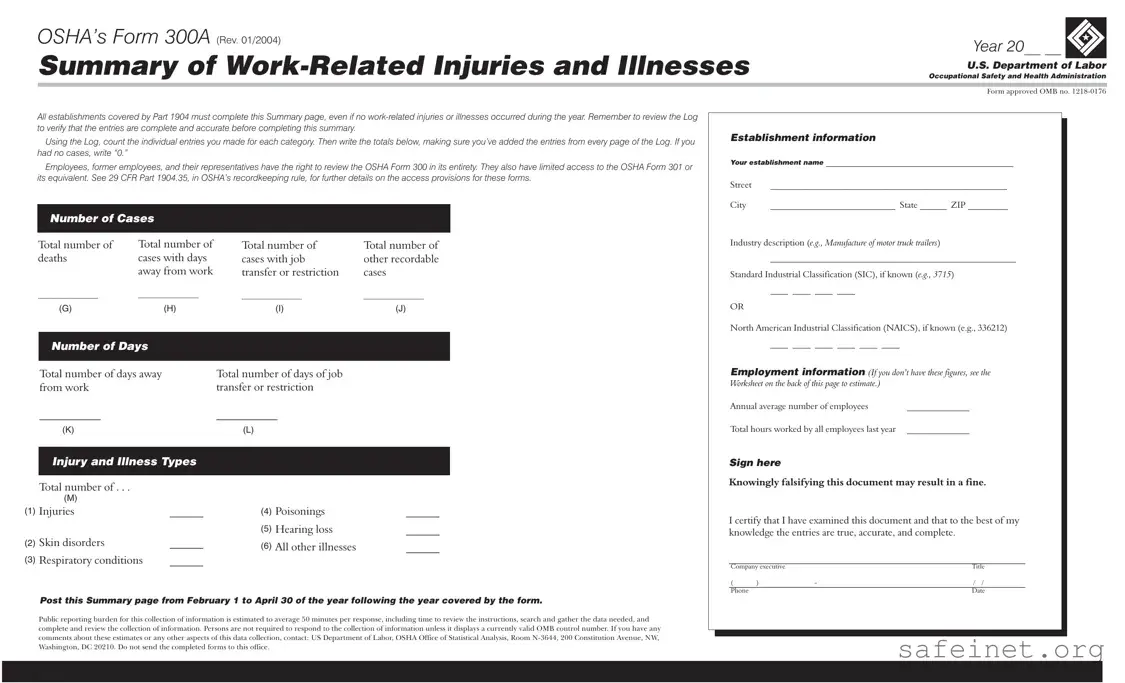
The OSHA Form 300A serves as a crucial summary of work-related injuries and illnesses that occur within a workplace during a calendar year. This form is a requirement for all establishments covered by OSHA's Part 1904, regardless of whether any incidents took place. The document must be filled out accurately, reflecting the total number of cases, including deaths and instances that resulted in days away from work or job restrictions. Employers must also provide specific establishment information, such as the name, address, and industry classification. The form captures various types of injuries and illnesses, ranging from skin disorders to respiratory conditions, allowing for a comprehensive overview of workplace safety. It is essential for employers to review their logs thoroughly before completing the summary, ensuring that all entries are correct and complete. Employees and their representatives have the right to access this form, which promotes transparency and accountability in workplace safety practices. Furthermore, the completed summary must be posted in a visible area from February 1 to April 30 of the following year, making it accessible to all employees.

| Fact Name | Fact Description |
|---|---|
| Form Purpose | The OSHA Form 300A summarizes work-related injuries and illnesses for a specific year. |
| Mandatory Completion | All establishments covered by OSHA’s Part 1904 must complete this form, regardless of whether any incidents occurred. |
| Review Requirement | Before completing the summary, establishments must review the Log to ensure accuracy and completeness of entries. |
| Employee Rights | Employees, former employees, and their representatives can review the entire OSHA Form 300. |
| Access to Forms | Access to OSHA Form 301 or its equivalent is limited but available to certain individuals under specific conditions. |
| Posting Requirement | Employers must post the completed summary from February 1 to April 30 of the following year. |
| Data Collection Burden | The average time to complete this form is estimated at 50 minutes, including data gathering and review. |
| Annual Average Employees | Establishments must report the annual average number of employees to provide context for the data. |
| Governing Law | This form is governed by OSHA's recordkeeping rule, specifically 29 CFR Part 1904. |
Completing the OSHA Form 300A is a straightforward process that requires accurate information about work-related injuries and illnesses. Ensure that you have gathered all necessary data from your Log before starting. This summary must be completed even if no incidents occurred during the year. Follow these steps to fill out the form correctly.
After completing the form, remember to post the summary page prominently from February 1 to April 30 of the following year. This ensures compliance with OSHA regulations and allows employees and their representatives access to the information. Be mindful that any falsification of this document can lead to penalties.
What is the purpose of the OSHA Form 300A?
The OSHA Form 300A serves as a summary of work-related injuries and illnesses that occur in a workplace over the course of a calendar year. It is a requirement for all establishments covered by OSHA regulations, even if no incidents occurred during that time. This form helps employers track workplace safety and provides valuable data for assessing and improving occupational health practices. By summarizing the number of cases, types of injuries, and the impact on employees, it plays a crucial role in promoting workplace safety and accountability.
Who is required to complete the OSHA Form 300A?
All employers who fall under the jurisdiction of OSHA and are covered by Part 1904 must complete the OSHA Form 300A. This includes businesses in various industries that have a certain number of employees or experience specific types of incidents. Even if there are no recorded injuries or illnesses, the form still needs to be filled out, indicating "0" for each category. Compliance with this requirement ensures that employers maintain accurate records and contribute to the overall safety culture within their industry.
When should the OSHA Form 300A be posted?
The completed OSHA Form 300A must be posted in a visible location within the workplace from February 1 to April 30 of the year following the reporting year. This time frame allows employees, former employees, and their representatives to review the summary of work-related incidents. Posting the form during this period helps raise awareness about workplace safety and encourages employees to engage in discussions regarding health and safety practices.
What are the consequences of falsifying the OSHA Form 300A?
Falsifying information on the OSHA Form 300A can lead to serious consequences, including fines and legal repercussions. The form includes a certification statement that requires the person completing it to attest that the information is true, accurate, and complete to the best of their knowledge. Misrepresentation or inaccuracies can undermine workplace safety efforts and may result in investigations or penalties from OSHA. Therefore, it is crucial for employers to ensure that all entries are carefully reviewed and verified before submission.
Neglecting to report zero cases: Many individuals mistakenly assume that if there were no work-related injuries or illnesses, they do not need to complete the form. However, every establishment must submit the 300A form, even if it is simply to report “0” cases.
Inaccurate data entry: It is crucial to ensure that all entries on the form are complete and accurate. Failing to double-check the totals from the Log can lead to discrepancies that may raise questions during audits.
Forgetting to include all pages of the Log: Some people overlook the importance of counting entries from every page of the Log. This oversight can result in underreporting cases, which could have serious implications.
Missing industry classification: Not providing the Standard Industrial Classification (SIC) or North American Industrial Classification (NAICS) can lead to confusion about the establishment's industry. This information is vital for regulatory purposes and helps in data analysis.
Incorrect certification: Signing the form without thoroughly reviewing the information can lead to unintentional inaccuracies. It is essential to certify that all entries are true and complete, as knowingly falsifying the document can result in penalties.
The OSHA Form 300A is a vital document for summarizing work-related injuries and illnesses in a workplace. However, it is often used in conjunction with several other forms and documents that help provide a comprehensive view of workplace safety and health. Understanding these related documents is crucial for maintaining compliance and ensuring a safe working environment.
By familiarizing yourself with these forms and documents, you can better manage workplace safety and compliance. Each document plays a significant role in creating a safer work environment and ensuring that all incidents are properly documented and addressed. Prioritize these records to enhance your organization’s safety culture and meet regulatory requirements.
Form 300, known as the Log of Work-Related Injuries and Illnesses, is closely related to Form 301, the Injury and Illness Incident Report. While Form 300 provides a summary of all work-related incidents over a year, Form 301 details each specific incident. Employers use Form 301 to document the specifics of an injury or illness, including the circumstances surrounding the event, the affected employee, and the nature of the injury. Both forms are essential for OSHA compliance, but they serve different purposes: one offers a broader overview, while the other focuses on individual incidents.
Another document similar to the OSHA Form 300A is the OSHA Form 300, which serves as the foundational log for recording work-related injuries and illnesses. This form is filled out throughout the year as incidents occur. It includes detailed entries for each case, such as the type of injury, the date it occurred, and the affected employee. The Form 300A is essentially a summary of the data collected in Form 300, making it a vital tool for tracking workplace safety trends over time.
Form 301 and Form 300A are also comparable to the First Report of Injury (FROI) used in many states for workers' compensation claims. The FROI documents the initial report of an employee's injury and is often required by state laws. Like the 300A, it summarizes significant details about the incident, such as the date of injury, the nature of the injury, and the circumstances. Both forms aim to ensure that injuries are reported accurately and timely, although the FROI is specifically tailored for workers' compensation purposes.
Form 300A shares similarities with the Employee Injury Report, often used by employers to gather initial information about an employee's injury. This report collects data from the employee immediately after the incident and may include witness statements and immediate actions taken. While the Employee Injury Report is typically an internal document, it feeds into the data that will later be summarized in the OSHA Form 300A, ensuring a comprehensive approach to workplace safety.
The OSHA Form 300A can also be likened to the Safety Data Sheet (SDS), which provides detailed information about hazardous materials used in the workplace. Although the SDS focuses on chemical safety, both documents play a crucial role in promoting a safe working environment. They inform employees about potential risks and necessary precautions, thereby fostering a culture of safety that aligns with the reporting requirements of the 300A.
Another related document is the Accident Investigation Report, which is often completed after a workplace incident. This report delves into the causes of the accident, contributing factors, and recommendations for preventing future occurrences. While the 300A summarizes injuries and illnesses, the Accident Investigation Report provides a deeper analysis of specific incidents, making both documents vital for improving workplace safety practices.
Lastly, the Return-to-Work Form is similar in that it documents an employee's transition back to work after an injury. This form outlines any restrictions or accommodations needed for the employee to safely resume their duties. While the 300A summarizes injury statistics, the Return-to-Work Form focuses on individual recovery and reintegration, highlighting the importance of supporting employees in their recovery process.
When filling out the OSHA Form 300A, it’s essential to approach the task with care and attention to detail. Here are six important dos and don'ts to keep in mind:
Understanding OSHA's Form 300A is essential for employers and employees alike. However, several misconceptions can lead to confusion about its purpose and requirements. Here are seven common misconceptions:
Understanding these misconceptions can help ensure compliance with OSHA regulations and promote a safer workplace.
Filling out and using OSHA's Form 300A is an essential process for employers to track work-related injuries and illnesses. Here are some key takeaways to consider: