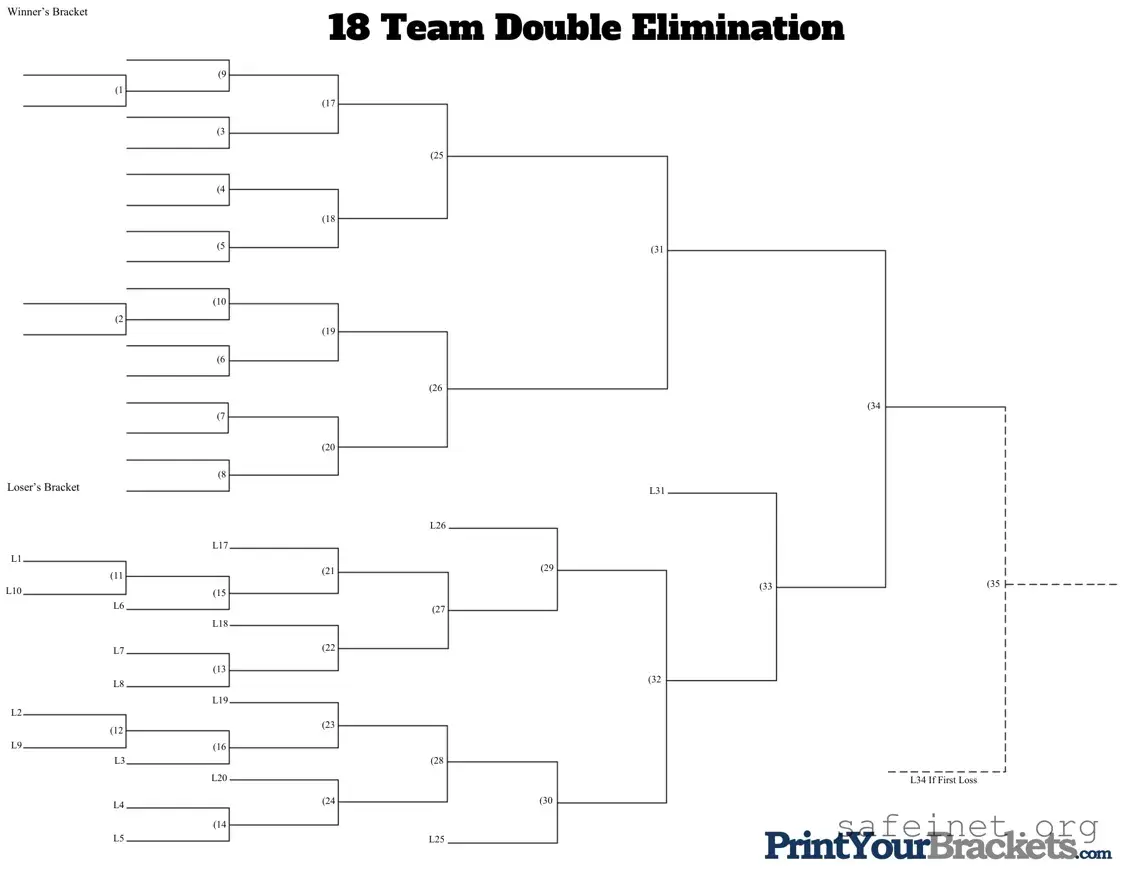
The 18 Double Elimination form is a structured way to manage tournament play, ensuring that every team has a fair chance to compete for the championship. In this format, teams are divided into two main brackets: the Winner's Bracket and the Loser's Bracket. The Winner's Bracket features initial matchups where teams compete to advance without any losses. However, once a team loses, they move to the Loser's Bracket, where they still have an opportunity to fight their way back to the finals. This system allows for a more forgiving competition, as a single loss does not eliminate a team from contention. The progression through the brackets is carefully organized, with match numbers and team placements clearly defined. For example, teams face off in a series of matches, with the outcomes determining who advances and who drops into the Loser's Bracket. Overall, the 18 Double Elimination format is designed to keep the competition exciting and engaging, giving teams multiple chances to showcase their skills and strategy.
| Fact Name | Details |
|---|---|
| Format Overview | The 18 Double Elimination format allows teams to lose once before being eliminated from the tournament. |
| Brackets Structure | It consists of a Winner's Bracket and a Loser's Bracket, ensuring teams have a second chance. |
| Team Count | This format accommodates 18 teams, making it suitable for larger tournaments. |
| Initial Matchups | The first round typically features 9 matches, with the winners advancing to the Winner's Bracket. |
| Loser's Bracket Entry | Teams that lose in the Winner's Bracket drop down to the Loser's Bracket for a chance to continue competing. |
| Finals Setup | The finals often include a match between the last remaining team from the Winner's Bracket and the Loser's Bracket. |
| Advancement Rules | Teams must win in the Winner's Bracket to avoid elimination; losing in the Loser's Bracket means elimination. |
| State-Specific Regulations | Various states may have specific rules governing tournament formats, including double elimination. |
| Governing Laws | In states like California, tournament rules must comply with local sports regulations and safety standards. |
| Popularity | This format is widely used in sports and esports, offering an engaging experience for both players and spectators. |
After completing the 18 Double Elimination form, you will have a clear layout of the tournament structure, showing how teams progress through the winner's and loser's brackets. This organization is essential for tracking match outcomes and determining the eventual champion. Follow the steps below to accurately fill out the form.
What is the 18 Double Elimination form?
The 18 Double Elimination form is a bracket layout used for tournaments involving 18 teams. It allows teams to compete in a way that gives them a second chance if they lose a match. The tournament continues until one team remains undefeated and another team has lost twice.
How does the winner's bracket work?
In the winner's bracket, teams compete against each other. The winners of these matches advance to the next round in the winner's bracket. If a team loses in this bracket, they move to the loser's bracket, where they still have a chance to compete for the championship.
What happens in the loser's bracket?
The loser's bracket is for teams that have lost a match in the winner's bracket. Teams here compete against each other, and the last team remaining in this bracket can still challenge the winner of the winner's bracket for the championship. However, this team must win twice to claim the title.
How many matches does each team play?
Each team could play multiple matches depending on their performance. A team that wins all its matches will play fewer games than a team that loses and continues in the loser's bracket. Generally, a team can play up to three matches if they lose once and continue through the loser's bracket.
What does it mean to have a first loss?
A first loss refers to the initial match a team loses in the tournament. After this loss, the team moves to the loser's bracket. They still have the opportunity to compete for the championship by winning all subsequent matches in the loser's bracket.
How are teams seeded in the bracket?
Teams are usually seeded based on their performance in prior tournaments or their ranking. The seeding affects matchups in the early rounds, with higher-seeded teams generally playing lower-seeded teams. This setup aims to ensure a fair competition.
What is the significance of the match numbers in the bracket?
The match numbers in the bracket indicate the sequence of matches played. Each match number corresponds to a specific pairing of teams. Following these numbers helps participants and spectators understand which teams are competing at each stage of the tournament.
Can a team that loses in the winner's bracket still win the tournament?
Yes, a team that loses in the winner's bracket can still win the tournament. They must compete in the loser's bracket and win all their matches. If they reach the final match against the winner of the winner's bracket, they must win twice to take the championship.
What should teams do if they have questions during the tournament?
If teams have questions during the tournament, they should reach out to the tournament organizers. Organizers can provide clarification on rules, match schedules, and any other concerns. It is important for teams to stay informed to ensure a smooth tournament experience.
When filling out the 18 Double Elimination form, individuals often encounter several common mistakes. These errors can lead to confusion and complications in the tournament process. Below is a list of four frequent mistakes:
Inaccurate Team Placement: Participants may place teams in the wrong brackets. For instance, a team that should be in the winner’s bracket might mistakenly be placed in the loser’s bracket. This error can disrupt the flow of the tournament.
Omitting Team Names: Some people forget to include the names of the teams. Without clear identification, it becomes difficult to track match progress and results. Always ensure that each team is clearly labeled.
Incorrect Match Results: Recording match outcomes incorrectly is another prevalent issue. When results are not entered accurately, it can lead to disputes and miscommunication among participants.
Failure to Follow Bracket Structure: Ignoring the established bracket structure can result in significant complications. Participants must adhere to the designated match-ups and progression rules to maintain the integrity of the tournament.
By being aware of these common mistakes, individuals can improve their accuracy when completing the 18 Double Elimination form, thereby ensuring a smoother tournament experience for everyone involved.
In organizing a double elimination tournament, several forms and documents are commonly used alongside the 18 Double Elimination form. Each document serves a specific purpose to ensure the tournament runs smoothly and efficiently. Here’s a list of key documents you may encounter:
Each of these documents plays a vital role in the organization and execution of a double elimination tournament. Proper management of these forms will contribute to a successful and enjoyable experience for all participants.
The 18 Double Elimination form shares similarities with the Single Elimination bracket. In a Single Elimination format, teams compete in a knockout style where the loser of each match is immediately eliminated from the tournament. This structure is straightforward and easy to follow, as each round reduces the number of teams by half. While the 18 Double Elimination form allows teams a second chance after losing, the core concept of organizing matchups in a bracket format remains consistent. Both formats aim to determine a champion, but the Single Elimination format does so in a more linear fashion, whereas the Double Elimination format introduces a more complex layer of competition.
The Round Robin format also resembles the 18 Double Elimination form in its approach to organizing matches among teams. In a Round Robin tournament, each team competes against every other team at least once. This ensures that every team has an equal opportunity to showcase their skills. While the 18 Double Elimination form emphasizes elimination after a second loss, the Round Robin format focuses on accumulating points or wins to determine the overall standings. Both formats require careful planning and scheduling to ensure that all matches are completed efficiently, making them popular choices for various types of competitions.
The Swiss-system tournament format is another document that shares characteristics with the 18 Double Elimination form. In a Swiss-system tournament, teams compete in a predetermined number of rounds, and each team is paired against opponents with similar records. This system allows for a balance of competition, as teams are not eliminated but rather continue to compete based on their performance. Similar to the Double Elimination format, the Swiss system aims to provide a fair chance for teams to demonstrate their abilities, although it does not incorporate the concept of elimination. Both formats require strategic planning to ensure that matchups are equitable and engaging.
Lastly, the Pool Play format bears a resemblance to the 18 Double Elimination form as well. In Pool Play, teams are divided into smaller groups or "pools," where they compete against each other. The top teams from each pool then advance to a knockout stage, similar to how teams in the Double Elimination format can continue competing even after a loss. Both formats emphasize the importance of initial matchups in determining which teams progress, while also allowing for multiple opportunities for teams to prove themselves. This structure fosters excitement and engagement, making both formats popular in various sporting events.
When filling out the 18 Double Elimination form, it is important to follow certain guidelines to ensure accuracy and clarity. Here is a list of things you should and shouldn't do:
Misconceptions about the 18 Double Elimination format can lead to confusion among participants and organizers alike. Here are ten common misunderstandings, along with explanations to clarify them.
When using the 18 Double Elimination form, it is essential to understand its structure and how to fill it out correctly. Here are some key takeaways: