Homepage > Blank 104 R Template
Article Structure

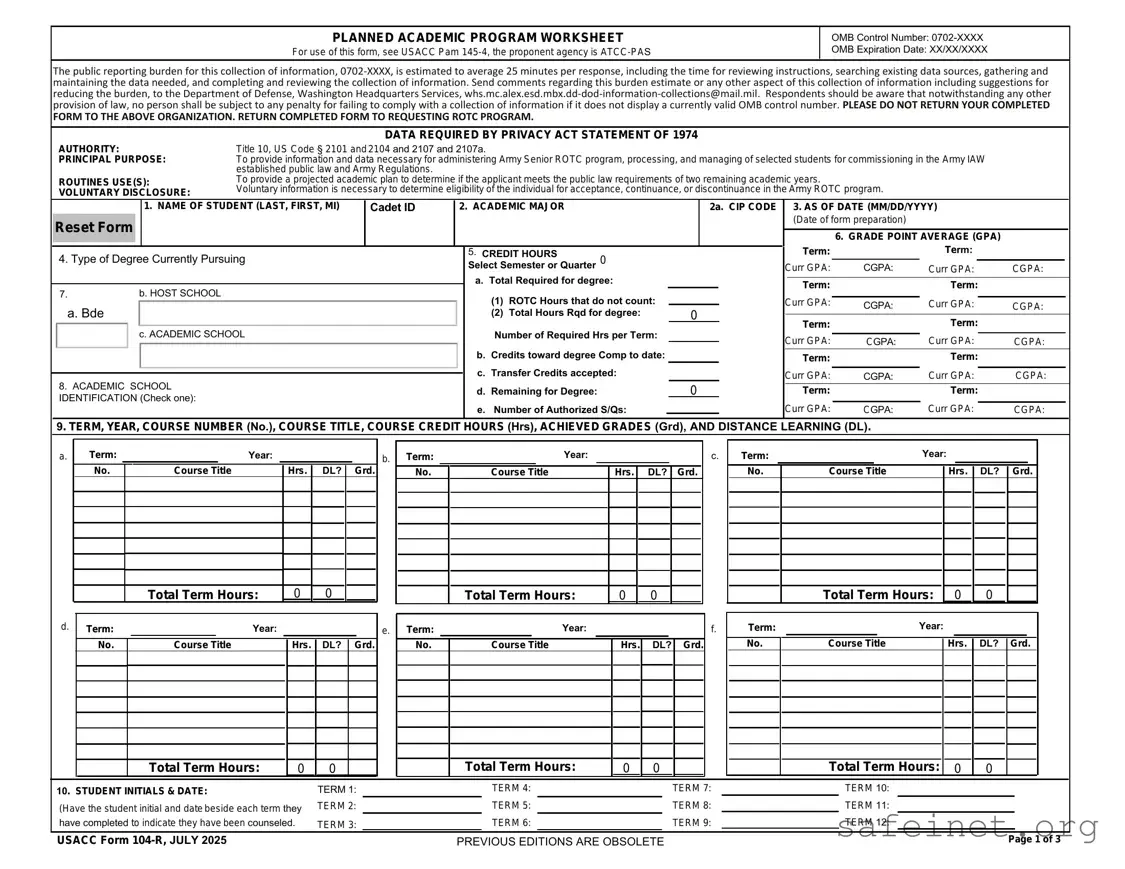
The 104 R form, known as the Planned Academic Program Worksheet, serves a vital role in the administration of the Army Senior ROTC program. This form is designed to gather essential information about a cadet's academic trajectory, ensuring compliance with public law and Army regulations. It requires students to outline their academic major, credit hours, and grade point averages, which help assess their eligibility for commissioning into the Army. The form includes sections for detailing courses taken, grades achieved, and credits earned towards their degree. Additionally, it incorporates a statement of understanding that confirms the cadet's commitment to completing a structured program approved by their educational institution. Through this comprehensive documentation, the 104 R form facilitates the monitoring of academic progress and supports the decision-making process regarding a cadet's continuation in the ROTC program.

Form Sample

For use of this form, see USACC Pam 145-4, the proponent agency is ATCC-PAS
PLANNED ACADEMIC PROGRAM WORKSHEET
DATA REQUIRED BY PRIVACY ACT STATEMENT OF 1974
AUTHORITY:
PRINCIPAL PURPOSE:
ROUTINES USE(S):
VOLUNTARY DISCLOSURE:
Title 10, US Code § 2101 and 2104 and 2107 and 2107a.
To provide information and data necessary for administering Army Senior ROTC program, processing, and managing of selected students for commissioning in the Army IAW
established public law and Army Regulations.
To provide a projected academic plan to determine if the applicant meets the public law requirements of two remaining academic years.
Voluntary information is necessary to determine eligibility of the individual for acceptance, continuance, or discontinuance in the Army ROTC program.
1. NAME OF STUDENT (LAST, FIRST, MI)
2. ACADEMIC MAJOR
2a. CIP CODE
3. AS OF DATE (MM/DD/YYYY)
(Date of form preparation)
6. GRADE POINT AVERAGE (GPA)
Term:
Term:
rm:
8. ACADEMIC SCHOOL
IDENTIFICATION (Check one):
Curr GPA: CGPA:
Curr GPA:
CGPA:
Term: Term:
Curr GPA:
CGPA:
Curr GPA:
CGPA:
a. Bde
Term:
Term:
Curr GPA:
CGPA:
Curr GPA:
CGPA:
Term:
Term:
Curr GPA:
CGPA:
Curr GPA:
CGPA:
Term: Term:
Curr GPA:
CGPA:
Curr GPA:
CGPA:
9. TERM, YEAR, COURSE NUMBER (No.), COURSE TITLE, COURSE CREDIT HOURS (Hrs), ACHIEVED GRADES (Grd), AND DISTANCE LEARNING (DL).
a.
b.
d.
e.
c.
f.
TERM 1:
TERM 2:
10. STUDENT INITIALS & DATE:
(Have the student initial and date beside each term they
have completed to indicate they have been counseled.
TERM 3:
TERM 4:
TERM 5:
TERM 6:
TERM 7:
TERM 8:
TERM 9:
Page 1 of 3
Term:
No. Course Title Hrs. DL? Grd.
Total Term Hours:
Term:
No. Course Title Hrs.
DL? Grd.
Total Term Hours:
Term:
No. Course Title Hrs. DL? Grd.
Term:
No. Course Title Hrs.
DL? Grd.
Total Term Hours:
Term:
No. Course Title Hrs.
DL? Grd.
Total Term Hours:
No. Course Title Hrs.
DL? Grd.
Total Term Hours:
4. Type of Degree Currently Pursuing
7.
b. HOST SCHOOL
c. ACADEMIC SCHOOL
5.
CREDIT HOURS
Select Semester or Quarter
a. Total Required for degree:
(1) ROTC Hours that do not count:
(2) Total Hours Rqd for degree:
Number of Required Hrs per Term:
b. Credits toward degree Comp to date:
c. Transfer Credits accepted:
d. Remaining for Degree:
e. Number of Authorized S/Qs:
Term:
Total Term Hours:
PREVIOUS EDITIONS ARE OBSOLETE
Cadet ID
Year:
Year:
Year:
Year:
Year:
Year:
TERM 10:
TERM 11:
TERM 12:
USACC Form 104-R, JULY 2025
OMB Control Number: 0702-XXXX
OMB Expiration Date: XX/XX/XXXX
The public reporting burden for this collection of information, 0702-XXXX, is estimated to average 25 minutes per response, including the time for reviewing instructions, searching existing data sources, gathering and
maintaining the data needed, and completing and reviewing the collection of information. Send comments regarding this burden estimate or any other aspect of this collection of information including suggestions for
reducing the burden, to the Department of Defense, Washington Headquarters Services, [email protected]. Respondents should be aware that notwithstanding any other
provision of law, no person shall be subject to any penalty for failing to comply with a collection of information if it does not display a currently valid OMB control number. PLEASE DO NOT RETURN YOUR COMPLETED
FORM TO THE ABOVE ORGANIZATION. RETURN COMPLETED FORM TO REQUESTING ROTC PROGRAM.
Reset Form
0
0
0
0
0
0
0
0
0
0
0
0
0
PLANNED ACADEMIC PROGRAM WORKSHEET
For use of this form, see USACC Pam 145-4, the proponent agency is ATCC-PAS
11. TERM, YEAR, COURSE NUMBER (No.), COURSE TITLE, COURSE CREDIT HOURS (Hrs), ACHIEVED GRADES (Grd), AND DISTANCE LEARNING (DL). (CONTINUED)
g.
h.
j. k.
m.
n.
i.
l.
o.
12. REVIEW: All of the above courses are required (as minimum) for the completion of the degree:
Completion should result in a
No (if no, list exceptions on reverse of this form).
13. SIGNATURE OF STUDENT: 14. DATE: (MM/DD/YYYY)
15. SIGNATURE OF REGISTRAR AND EXAMINER OF CREDENTIALS OR ROTC ADVISOR (OR OTHER INSTITUTION CERTIFYING OFFICIAL):
16. DATE: (MM/DD/YYYY)
USACC Form 104-R, JULY 2025 Page 2 of 3
Term:
No. Course Title Hrs. DL? Grd.
Total Term Hours:
Term:
No. Course Title Hrs.
DL? Grd.
Total Term Hours:
Term:
No. Course Title Hrs.
DL? Grd.
Total Term Hours:
Term:
No. Course Title Hrs.
DL?
Grd.
Total Term Hours:
Term:
No. Course Title
Hrs.
DL? Grd.
Total Term Hours:
Term:
No. Course Title Hrs.
DL? Grd.
Total Term Hours:
Term:
No. Course Title Hrs.
DL? Grd.
Total Term Hours:
Term:
No. Course Title
Hrs.
DL? Grd.
Total Term Hours:
Term:
No. Course Title
Hrs.
DL?
Grd.
Total Term H
ours:
(Degree Type)
Yes
Completion Date (Month, Year)
(Academic Discipline)
PREVIOUS EDITIONS ARE OBSOLETE
Year:
Year:
Year:
Year:
Year:
Year:
Year:
Year: Year:
OMB Control Number: 0702-XXXX
OMB Expiration Date: XX/XX/XXXX
0
0
0
0
0
0
0
0
0
0
0
0
0
0
0
0
0
0
PLANNED ACADEMIC PROGRAM WORKSHEET
For use of this form, see USACC Pam 145-4, the proponent agency is ATCC-PAS
STATEMENT OF UNDERSTANDING
We, the undersigned, hereby declare that the program outlined on the worksheet (on the reverse side of this statement) that
Cadet
is about to under take a formally structured program approved by
(FULL NAME, Last, First, MI) (Name of University or College)
designed to meet the requirments of a degree; that the degree to be attained is the culmination of an
(Type of Degree)
undergraduate college program of at least four years or graduate degree program of no more than two years; and that the remaining credit hour
s shown on
the worksheet are necessary either to fulfill discipline requirements or to fulfill credit hour requirements, or both, for the attainment of the degree. If the Cadet
is an ROTC Scholarship participant, the scholarship will be in force for the number of semesters indicated in Block 5.
IAW USACC Pam 145-4, the worksheet must be reviewed annually (at a minimum) for each contracted Cadet and revised, as necessary. The worksheet
must be authenticated by an appropriate school academic official (academic advisor/counselor) when completed or revised. The PMS will review the
worksheet with the Cadet each school term to monitor alignment/mission set and academic progress. This review will be noted on Cadet counseling records.
Any changes to this degree plan, adding/dropping classes, or change of major must first be discussed/approved with the PMS.
(Date) (MM/DD/YYYY)
(Date) (MM/DD/YYYY)
(CADET SIGNATURE)
(PROFESSOR OF MILITARY SCIENCE SIGNATURE)
USACC Form 104-R, JULY 2025
Page 3 of 3
PREVIOUS EDITIONS ARE OBSOLETE
OMB Control Number: 0702-XXXX
OMB Expiration Date: XX/XX/XXXX
Instructions for Planned Academic Program Worksheet USACC 104-R
Reset Form button erases the form.
1. Cadet’s name and Cadet ID
2. Cadet’s Academic Major. 2a. Only used for HQ STEM Scholarships. Not necessary for
all other scholarships.
3. Date of form preparation or date of form update.
4. Select type of degree the Cadet is pursuing Bachelors, Masters, or Associates (MJC
Only).
5. Block 5 calculates how many scholarship terms the Cadet needs to graduate.
Dropdown: select appropriate term type and degree plan. NOTE: Making the correct
selection is required for Block 5 to calculate correctly.
a. Input the total hours required for the degree
1) Input ROTC hours that are not included in the total for the degree.
2) Populates the sum of 5a and 5a(1)
3) Calculates the average number of hours required for each term based
on the selection in the dropdown and the sum from 5a(2).
b. Input the number of credit hours the Cadet has completed (if any) to date at the
school.
c. Input any transfer credits the school has accepted.
d. Calculates how many hours the Cadet has remaining for their degree.
e. Calculates the number of scholarship terms the Cadet needs to complete their
degree based on calculations from 5a(3) and 5d.
6. Input the term GPA and the cumul
ative GPA for each term completed.
7. Select the Cadet’s Brigade, ROTC Program, and Academic School.
8. Select Academic School’s identification: If the academic school is the same as the Host
School, select Host; If the academic school is not the Host School, select either
Extension Unit or Cross-Town.
1. Host Academic School is the Same as Host School.
2. Extension Unit Academic School is a manned partner school.
3. Cross-Town Academic School is an unmanned partner school.
NOTE: Cadet must take ROTC classes at Host school or nearest
manned Extension Unit.
9. Each group represents one term. Select the term from the dropdown: Fall, Winter (for
quarter schools), Spring, or Summer; Select the year for the term selected; input the
Course Number, Course Title, course Credit Hours, check the column for DL? if the
class is online. Once the term is finished, input the grade received.
10. Student should initial and date beside each term.
11. Follow the instructions for #9 above.
12. Verify that the courses listed above in #9 and #11 are required for the degree. Input the
expected graduation date.
13. Signature of Cadet.
14. Date Cadet signed document.
15. Signature of Registrar or ROTC advisor and other institution certifying official.
16. Date certifying official signed document.
17. Statement of Understanding. Cadet should read the Statement of Understanding and
then sign and date; PMS should sign and date.

Document Specifications

Fact Name Fact Description
Authority This form is governed by Title 10, US Code 2101 and 2104.
Principal Purpose The form collects information for managing the Army Senior ROTC program and processing students for commissioning.
Routine Use It provides a projected academic plan to ensure applicants meet public law requirements for their remaining academic years.
Voluntary Disclosure Providing information is voluntary but essential for determining eligibility for the Army ROTC program.
Student Information Students must provide their name, academic major, CIP code, and other details on the form.
Course Tracking The form tracks courses, credit hours, and grades, ensuring students meet degree requirements.
Initials and Counseling Students must initial and date beside each term to confirm they have been counseled about their academic plan.
Review Requirement A review section requires confirmation that all listed courses are necessary for degree completion.
Signatures The form requires signatures from the student, registrar, and professor of military science to validate the academic program.

Steps to Filling Out 104 R

Filling out the 104 R form is an important step in the academic planning process for students involved in the Army ROTC program. This form collects essential information regarding a student's academic trajectory and ensures they meet the necessary requirements for commissioning. Proper completion of the form is crucial for maintaining eligibility and ensuring a smooth transition through the program.

  1. Start with your personal information: Fill in your name (last, first, middle initial) in the designated section.
  2. Academic details: Enter your academic major and the corresponding CIP code.
  3. Date of preparation: Write the date in MM/DD/YYYY format.
  4. Academic institution: Specify the name of your academic school.
  5. Credit hours: Indicate the total credit hours required for your degree.
  6. Grade Point Average (GPA): Provide your current GPA along with the cumulative GPA.
  7. Select semester or quarter: Mark whether you are following a semester or quarter system.
  8. Course details: List the term, year, course number, title, credit hours, credits counting towards your degree, and achieved grades for each course.
  9. Initials and date: Have the student initial and date beside each term to confirm counseling.
  10. Review requirements: Answer whether all listed courses are required for your degree, and if not, note exceptions on the back of the form.
  11. Signatures: Include your signature and the date, then obtain the signature of the registrar or certifying official along with the date.
  12. Statement of understanding: Complete the statement, ensuring you declare the program outlined meets the requirements for your degree.

More About 104 R

What is the purpose of the 104 R form?

The 104 R form, known as the Planned Academic Program Worksheet, is essential for managing the Army Senior ROTC program. It collects information necessary to assess a student's eligibility for commissioning in the Army. The form helps ensure that students meet the public law requirements for their remaining academic years. By outlining a projected academic plan, it assists both the student and the institution in tracking progress toward degree completion.

Who needs to fill out the 104 R form?

This form must be completed by students participating in the Army ROTC program. Specifically, it is aimed at cadets who are planning their academic courses to ensure they meet the requirements for commissioning. The form is also used by academic institutions to verify that students are on track to complete their degrees within the designated timeframe.

What information is required on the 104 R form?

The form requires various pieces of information, including the student's name, academic major, credit hours, and grade point average. Students must also provide details about their courses, such as course numbers, titles, credit hours, and achieved grades. Additionally, the form includes a section for students to confirm that they have been counseled on their academic progress and remaining requirements.

What happens if a student does not provide the required information on the 104 R form?

While providing information on the 104 R form is voluntary, failing to do so can have significant consequences. Without the necessary details, the institution may not be able to determine the student's eligibility for acceptance or continuation in the Army ROTC program. This could potentially jeopardize the student's scholarship status or commissioning opportunities, making it crucial to complete the form accurately and thoroughly.

Common mistakes

  1. Incomplete Student Information: Failing to provide the full name of the student, including last name, first name, and middle initial, can lead to processing delays.

  2. Incorrect Academic Major: Listing an incorrect academic major or failing to include the CIP code can result in misalignment with program requirements.

  3. Missing Dates: Not filling in the "as of date" (MM/DD/YYYY) can cause confusion regarding the timing of the information provided.

  4. Errors in Course Information: Providing inaccurate course numbers, titles, or credit hours can affect the evaluation of academic progress.

  5. Signature Issues: Neglecting to obtain the necessary signatures from the student and the registrar can render the form invalid.

Documents used along the form

The 104 R form, known as the Planned Academic Program Worksheet, plays a crucial role in managing the academic progress of students in the Army Senior ROTC program. Alongside this form, several other documents are commonly utilized to support the administration of the program and ensure students meet their academic and commissioning requirements. Below is a list of these important forms and documents.

  • ROTC Enrollment Application: This document is essential for students applying to join the ROTC program. It collects personal information, academic history, and other relevant details necessary for the evaluation of eligibility.
  • Scholarship Application Form: Students seeking financial assistance through ROTC scholarships must complete this form. It outlines the applicant's academic achievements, extracurricular activities, and financial need, helping to determine scholarship eligibility.
  • Cadet Contract: This legally binding agreement outlines the commitments and obligations of the cadet in the ROTC program. It includes details about service requirements, scholarship terms, and conditions for program participation.
  • Academic Progress Report: This report is used to track a cadet's academic performance throughout their time in the program. It provides an overview of grades, credits earned, and any academic challenges faced, ensuring that students remain on track for graduation.
  • Advising and Counseling Record: This document captures the details of academic counseling sessions between the cadet and their advisor. It serves as a record of discussions about academic goals, course selections, and any adjustments needed in the cadet's academic plan.

These documents, when used in conjunction with the 104 R form, help create a comprehensive framework for supporting cadets in their academic and military training journeys. Each form serves a specific purpose, contributing to the overall success and preparedness of students as they work toward their commissioning in the Army.

Similar forms

The 104 R form, known as the Planned Academic Program Worksheet, shares similarities with the Academic Plan form used by various educational institutions. Both documents serve the purpose of outlining a student's academic trajectory. They require students to list their courses, credit hours, and grades, helping to ensure that they meet the requirements for graduation. The Academic Plan form also emphasizes the importance of academic advising, encouraging students to seek guidance to stay on track for their degree completion.

Another document that resembles the 104 R form is the Degree Audit Report (DAR). A DAR provides a comprehensive overview of a student's academic progress toward their degree. Like the 104 R, it includes information on completed courses, grades, and remaining requirements. The DAR is often used by academic advisors to assist students in understanding what they still need to complete for graduation, making it a vital tool for academic planning.

The Course Registration form is also similar in function to the 104 R form. This document allows students to officially enroll in their selected courses for a given term. Both forms require students to provide details about their academic schedule, such as course titles and credit hours. While the 104 R focuses on long-term academic planning, the Course Registration form is more immediate, dealing with enrollment for the upcoming semester.

The Transfer Credit Evaluation form is another related document. This form assesses which credits from previously attended institutions can be applied toward a student's current degree program. It shares the goal of helping students understand their academic standing and what they need to graduate. Both forms require detailed information about courses and credits, although the Transfer Credit Evaluation specifically focuses on credits earned elsewhere.

The Academic Probation form is similar in that it addresses a student's academic standing. When a student falls below a certain GPA, this form is used to outline the steps they must take to return to good standing. Like the 104 R, it emphasizes the importance of academic progress and often requires a plan for improvement, making it a critical tool for students facing academic challenges.

The Enrollment Verification form also shares characteristics with the 104 R form. This document is used to confirm a student's enrollment status at an institution. Both forms require personal information and details about the student's academic program. Enrollment Verification is often needed for financial aid or insurance purposes, while the 104 R is more focused on academic planning and progression.

The Graduation Application form is another document that aligns with the 104 R. This form is submitted by students nearing the completion of their degree requirements. It requires students to confirm that they have met all academic criteria for graduation, similar to how the 104 R outlines the courses necessary for degree completion. Both forms play a crucial role in the final stages of a student's academic journey.

Lastly, the Financial Aid Application form has similarities to the 104 R form in that it collects essential information to determine a student's eligibility for financial assistance. Both documents require personal and academic information, allowing institutions to evaluate a student's situation. While the 104 R focuses on academic planning, the Financial Aid Application is concerned with the financial aspects of a student's education.

Dos and Don'ts

When filling out the 104 R form, it is essential to follow specific guidelines to ensure accuracy and compliance. Below is a list of things to do and avoid:

  • Do provide complete and accurate information for each section, including your name, academic major, and GPA.
  • Do double-check all entries for correctness before submitting the form.
  • Do ensure that the course titles and credit hours match those listed in your academic records.
  • Do obtain necessary signatures from both the student and the registrar.
  • Don't leave any fields blank; all required sections must be filled out.
  • Don't use abbreviations or shorthand that may confuse the reviewer.
  • Don't submit the form without verifying that it meets all program requirements.
  • Don't forget to date the form and ensure it is signed by all necessary parties.

Misconceptions

Here are nine misconceptions about the 104 R form, along with clarifications for each:

  • It is only for ROTC students. The 104 R form is primarily used for Army ROTC students, but it can also apply to other cadets involved in similar programs.
  • Completion of the form guarantees commission in the Army. While the form is important for planning, it does not guarantee commission. Other eligibility criteria must also be met.
  • The form only tracks grades. The 104 R form is not just about grades; it also outlines academic plans and credit requirements for degree completion.
  • It must be filled out by the student alone. The form requires input from academic advisors or registrars to ensure accuracy and compliance with program requirements.
  • Once submitted, it cannot be changed. Changes can be made if circumstances change, but they must be properly documented and approved.
  • It is a one-time requirement. The 104 R form may need to be updated each semester or quarter to reflect the student's current academic status and plans.
  • Only GPA matters on the form. While GPA is important, the form also considers credit hours, course requirements, and overall academic progression.
  • It is not necessary for transfer students. Transfer students must also complete the form to ensure their previous credits align with their new academic program.
  • The form is not subject to review. The 104 R form can be reviewed by academic officials to verify that students are on track to meet their degree requirements.

Key takeaways

Here are key takeaways for filling out and using the 104 R form:

  • The form is essential for students in the Army Senior ROTC program.
  • Complete all sections accurately to ensure proper processing.
  • Provide your full name, academic major, and CIP code at the top.
  • Indicate the date of form preparation in MM/DD/YYYY format.
  • List all required courses along with their credit hours and grades.
  • Ensure that the total credit hours align with degree requirements.
  • Initial and date next to each term to confirm counseling has occurred.
  • Review the courses to verify they meet minimum degree completion criteria.
  • Obtain necessary signatures from both the student and the registrar.
  • Submit the form in a timely manner to avoid delays in your ROTC scholarship.